

Total: MRP Rs.0
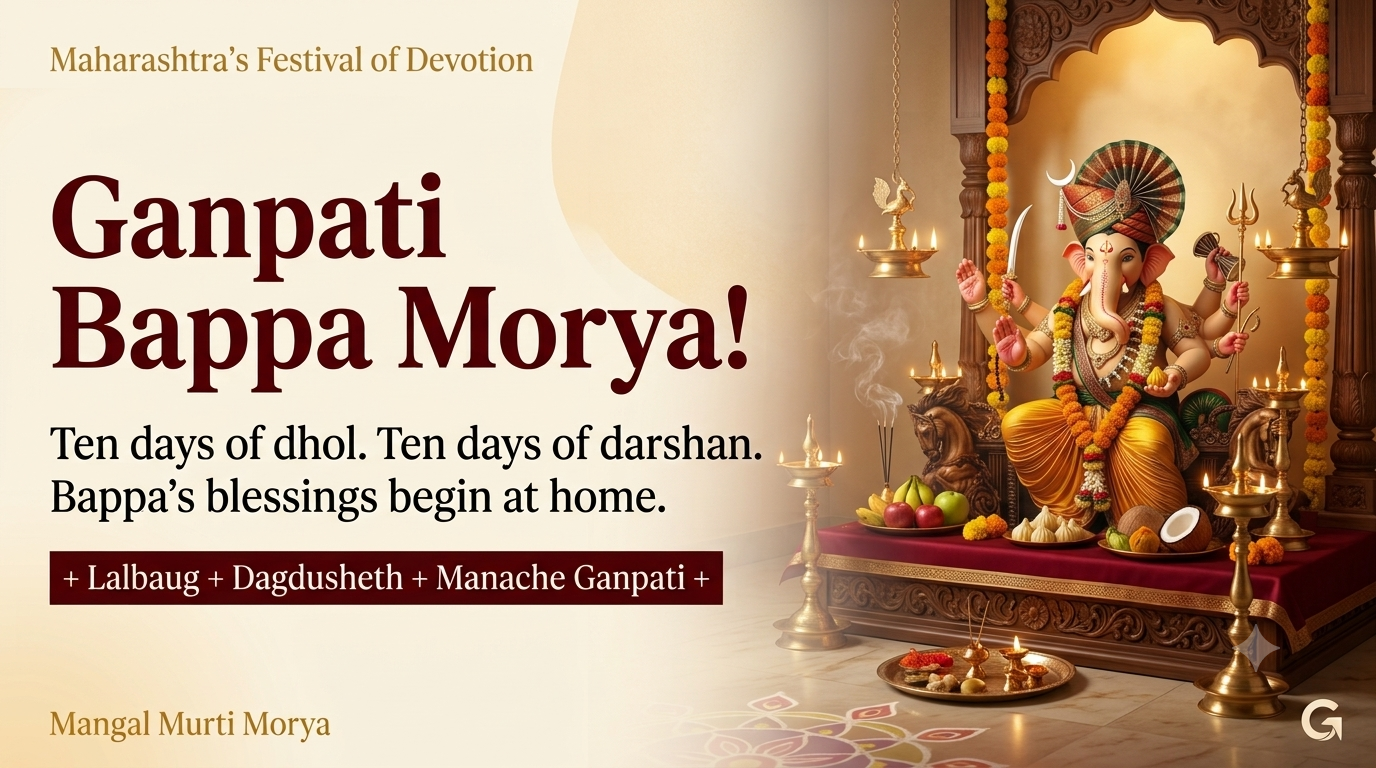
Ganesh Chaturthi 2026 falls on Monday, 14 September 2026. The Madhyahna Puja Muhurat is around 11:09 AM to 1:35 PM, and the grand ten day Visarjan is on Anant Chaturdashi, Friday, 25 September 2026.
If you have ever stood in that winding queue at Lalbaug at four in the morning, or heard the dhol echo off Pune's old wada walls in September, you already know the feeling. Nothing in Maharashtra says "Bappa is home" quite like Ganesh Chaturthi. This is not just a festival here. It is a homecoming.
So let's take you through it. From the crowded lanes of Mumbai and Pune to your own living room, one candle lit aarti at a time. By the end, you will know the most famous Ganpati in Maharashtra, the stories behind him, and exactly what your pooja needs. Spoiler: one neat little combo can cover most of it.
Why Ganesh Chaturthi Is Maharashtra's Biggest Festival
Ganesh Chaturthi, also called Ganeshotsav or Ganpati Utsav, falls on the fourth day, the Chaturthi, of the bright fortnight of Bhadrapada. What makes Maharashtra special is the Sarvajanik Ganeshotsav, the public celebration. For ten days, every mandal, every galli, and every chowk becomes a temple.
You can thank Lokmanya Bal Gangadhar Tilak for that. In 1893, he organised the first Sarvajanik Ganeshotsav from Kesari Wada in Pune. His idea was bigger than devotion alone. He wanted to bring people together as one community under British rule, and the festival became a national movement. Over a century later, that same energy fills every darshan queue you see today. When you hear "Ganpati Bappa Morya" shouted by ten thousand voices at once, you understand exactly what he built.
The Famous Ganpati in Mumbai
Lalbaugcha Raja, the Navasacha Ganpati of Mumbai
Ask anyone in Mumbai which is the most famous Ganpati in the city, and the answer comes back in seconds: Lalbaugcha Raja. The Lalbaugcha Raja Sarvajanik Ganeshotsav Mandal was founded in 1934 at the Putlabai chawl in Lalbaug, Parel. Locals call him Navasacha Ganpati, the wish fulfilling lord. People genuinely believe that a wish made at his feet comes true, and that is why the queue stretches for twenty or even thirty hours during the festival. Devotees arrive with flowers, with nariyal, with their whole families, and they wait without complaint. Trust us, the darshan is worth every hour.
Just a little away, Mumbaicha Raja of the Lalbaug Sarvajanik Utsav Mandal holds two world records: the tallest Ganesh idol tradition since 1977, and the world's largest 24 karat gold idol. If you are in Mumbai during Chaturthi, these two names alone tell you the scale of the city's love for Bappa.
Shree Siddhivinayak Temple, Prabhadevi
For a permanent home of Lord Ganesha in Mumbai, head to Shree Siddhivinayak Temple in Prabhadevi. It was built on 19 November 1801 by Laxman Vithu and Deubai Patil, and what began as a small shrine is now one of the busiest temples in India. Locals will tell you that darshan here grants Siddhi, success, and removes obstacles from your path. During Ganeshotsav, the queue outside Siddhivinayak is its own Maharashtrian ritual, and everyone from cricketers to cab drivers makes time for it.
The Famous Ganpati in Pune
Shrimant Dagdusheth Halwai Ganpati
Pune has its own beloved face of Bappa: Dagdusheth Halwai Ganpati, installed in 1893 by Dagdusheth Halwai, a successful sweet seller, and his wife Lakshmibai. Their story is a moving one. After losing their only son to a plague epidemic, they turned their grief into faith and installed this idol in Budhwar Peth. Today the temple is known for its grand silver and gold ornaments, and for its generous annadanam that feeds thousands of devotees daily. On Chaturthi, lakhs of people come for darshan, and the one day visarjan of Dagdusheth turns the whole city into a celebration.
The Five Manache Ganpati of Pune
Pune adds something no other city has: the Manache Ganpati, the five mandals ranked by honour. The ranking is a matter of fierce devotion here, and every Puneite can recite it from memory.
- Kasba Ganpati (first, Manacha Pahila): Pune's guardian deity, the Gram Daivat of the city.
- Tambdi Jogeshwari Ganpati (second): installed so that public spirited citizens could have darshan.
- Guruji Talim Ganpati (third): the favourite of wrestlers and athletes from the city's talim tradition.
- Tulshibaug Ganpati (fourth): established in 1901, with a striking 13 feet tall idol draped in royal ornaments.
- Kesariwada Ganpati (fifth): linked to Lokmanya Tilak's Kesari Wada, where the sarvajanik utsav itself began.
On visarjan day, the honour of being the first to immerse is a competition of love. Watch it once and you will never forget it.
The Stories of Lord Ganesha
The Birth of Ganesha: How the Elephant Head Came to Be
Every Maharashtrian child hears this story before they can walk. The most widely told version goes like this. One day, while Lord Shiva was away in deep meditation, Goddess Parvati shaped a young boy from the oils and dust of her own body, some say from sandalwood paste, and breathed life into him. She set him at the door of her chambers and told him to let no one pass while she bathed.
When Shiva returned, this unknown boy stood in his way. Shiva, not knowing the boy was his own son, flew into a rage and severed his head. Parvati's grief shook the heavens, and Shiva, to undo his mistake, sent his ganas out with one instruction: bring back the head of the first living being they found facing north, the direction of wisdom. They returned with the head of an elephant, Shiva placed it upon the boy, and Ganesha was reborn, larger than life. There are other versions of this tale in different texts, some where Shiva creates him outright, but the heart of every telling is the same: out of loss came devotion, and out of the elephant came wisdom.
Why Ganesha Loves Modak, and Why You Offer 21
Every Ganesh Chaturthi, the first thing on the thali is modak. The story behind it is a family story. When Devi Anusuya once hosted Lord Shiva, Goddess Parvati, and young Ganesha, she served them so many delicious modaks that little Ganesha's belly filled to its famous round shape. The tale is told with a smile in every Maharashtrian home, and it is exactly why 21 modaks are offered to Bappa every Chaturthi, one for each prayer of knowledge, prosperity, and protection.
Why Ganesha Is Worshipped First: The Vighnaharta
Ganesha is always worshipped first, before any other god, because he is Vighnaharta, the remover of obstacles. That is why Ganesh Chaturthi is considered the perfect day for new beginnings, for first school steps, for new business ventures, for anything you want to start with blessings. When Bappa arrives in a Maharashtrian home, he arrives like a beloved family member, and the whole house feels it.
Many devotees also repeat the simple mantra Om Gam Ganapataye Namaha, which means "I bow to Ganesha, the remover of obstacles." And because he is seen as the keeper of hidden knowledge, he is also considered the presiding deity of astrology, which is why students, seekers, and those who study the stars pray to him before beginning anything of importance.
The Race Around the World: Wisdom Over Speed
There is a beloved story that parents in Maharashtra retell every September. Once Shiva and Parvati set a challenge for their two sons. Whoever circled the entire world first would win a great prize. Kartikeya, swift and proud, mounted his peacock and flew off at once. Ganesha, in no hurry at all, walked three slow, reverent circles around his parents and then stopped, smiling.
When they asked what he was doing, he said, "You two are my whole world." Shiva and Parvati were so moved that they declared him the winner. The lesson has travelled down the centuries: the one who honours his roots walks farther than the one who simply runs. It is the reason every child in Maharashtra is taught to touch their elders' feet before the aarti begins.
The Scribe of the Mahabharata
Ask why Ganesha has one broken tusk, and you will hear the story of the great book. When the sage Vyasa decided to dictate the epic Mahabharata, he asked Ganesha to be his scribe. Ganesha agreed on one condition: Vyasa must recite without stopping, not even for a breath. Vyasa accepted, but set a condition of his own: Ganesha must fully understand the meaning of every verse before he wrote it down.
And so the greatest story ever told was written, verse by verse. When Ganesha's writing pen gave way in the middle of the work, he simply broke off his own tusk and used it to continue. That is why, to this day, you will always see one tusk missing in his idols. A reminder that no task is too great when you bring your whole self to it.
Decoding Ganesha's Form: Every Symbol Has a Meaning
Nothing in Ganesha's form is accidental, and once you know the meanings, a darshan becomes a completely different experience.
- The elephant head: wisdom, patience, and the memory to hold it all.
- The round belly: the entire universe contained within, and the lesson that nothing should ever weigh you down.
- The snake around the waist: the coiled energy that holds the cosmos together, and mastery over one's desires.
- The tiny mouse at his feet: the restless, wandering mind, tamed and carried gently under the weight of knowledge.
- The four hands: the axe that cuts away attachments, the noose that pulls you toward your highest goal, the modak that rewards steady devotion, and the raised palm that blesses and protects.
When you bow before Bappa, you are rehearsing every one of these lessons without saying a word.
The Ashtavinayak Yatra
For those who want more of Bappa, Maharashtra offers the Ashtavinayak Yatra, a pilgrimage of eight self born, swayambhu, Ganesha temples, each with its own legend. The journey traditionally begins at Mayureshwar Temple in Morgaon, where Lord Ganesha, riding a peacock, is believed to have slain a demon. Many devotees time their yatra around the Ganeshotsav season, and honestly, it is one of the most peaceful ways to experience Maharashtra's devotion.
Ganesh Chaturthi 2026 Dates and Muhurat
| Event | Date (2026) |
|---|---|
| Ganesh Chaturthi (Sthapana) | Monday, 14 September 2026 |
| Madhyahna Puja Muhurat | Around 11:09 AM to 1:35 PM |
| Half day Visarjan | 15 September 2026 |
| 3, 5, or 7 day Visarjan | 17, 19, or 21 September 2026 |
| Anant Chaturdashi (ten day Visarjan) | Friday, 25 September 2026 |
If you are placing a new idol at home, the ideal time is when the Chaturthi Tithi begins on the morning of 14 September. Light the deepam, keep it burning through the aarti, and let the fragrance do its work.
Ganpati Puja Essentials: What Belongs on Your Thali
A proper Ganpati Sthapana comes alive with a handful of sattvic items. Here is what a traditional list looks like, and what each thing does.
- Kumkum and Haldi: for the tilak, the auspicious mark of welcome.
- Sindoor: applied on the idol as a sign of devotion.
- Chandan (sandalwood): for the chandan tilak and a calming scent.
- Mauli (sacred red thread): tied around the wrist and the kalash.
- Gangajal: to purify the space before sthapana.
- 21 blades of Durva grass: Ganesha's favourite offering, essential on the thali.
- Flowers, betel leaves, and betel nuts: for pushpanjali and panchamrit.
- Modak and bhog: the naivedya that makes Bappa smile.
- Camphor: for the glowing kapoor aarti that ends every prayer.
- Ghee or oil for the deepam: the steady flame of devotion.
- Agarbatti, incense sticks: the smoke that carries your prayers upward.
Notice the last three. Camphor, the aarti flame, a long burning diya, and incense rising through the house. That is the atmosphere of every Maharashtrian pandal, recreated at home. And that is exactly where a good pooja kit earns its place on your thali.
One Combo, Everything You Need: Bappa's Blessings by HEM
Let's be honest. Festival mornings are chaotic. The house smells of modak, relatives are arriving, and someone always realises at the last moment that the camphor tin is empty. That is why we built the Bappa's Blessings Combo, to take one worry off your plate.
Inside the box you will find:
- HEM Aradhana Camphor (100 g): pure, potent camphor to cleanse your space and for the final kapoor aarti.
- HEM Aradhana Pooja Ghee (450 ml): smokeless and long burning, so your diya stays steady through the whole aarti without smoke in your eyes.
- HEM Aradhana Pooja Oil (900 ml): the deepam essential, perfect for lighting and for daily rituals through the ten days.
- HEM Precious Chandan Incense Sticks (120 sticks, 6 packs of 20): one big sandalwood box holding six neat hexa packs of twenty sticks each, so you get a full 120 sticks of soothing sandalwood fragrance that calms the mind and lifts the soul, the classic agarbatti for Ganesh Chaturthi.
Every item in the combo maps to the traditional essentials we listed above. Camphor, check. Diya fuel, check. Incense, check. One box, one thali, zero last minute panic. And here is the fun part: this is just one of the many pooja collections HEM offers. Whether you want masala agarbatti for the evening aarti, dhoop cups for the pooja room, or ghee diyas for visarjan night, there is more where this came from.
Right now the combo is priced at Rs. 726 instead of the regular MRP of Rs. 920, a 21% discount on a limited time deal. More than 3,444 families have already brought it home.
👉 Shop the Bappa's Blessings Combo and complete your Ganpati Pooja samagri
No hard sell, promise. Just a calmer festival morning.
A Simple Ganpati Sthapana at Home, Step by Step
- Prepare the space. Clean the pooja room, decorate it with flowers and rangoli, and place the idol on a red cloth on a raised seat, facing east.
- Install the idol. Do the sankalpa, invite Bappa, and offer red flowers, kumkum, haldi, and 21 blades of durva.
- Light the deepam. Use the ghee diya or the pooja oil lamp and keep it burning throughout the aarti.
- Offer the bhog. Modaks, puran poli, fruits, whatever your family's tradition says. Bappa's favourite is modak, so never skip it.
- Perform the aarti. Wave the camphor flame slowly, with chandan incense smoke curling upward, and sing along with the family.
- Repeat daily. Offer flowers and fragrance each morning and evening until visarjan, and let Bappa feel at home.
Ganesh Chaturthi 2026 FAQ
When is Ganesh Chaturthi in 2026? Ganesh Chaturthi 2026 is on Monday, 14 September 2026. The Madhyahna Puja Muhurat is around 11:09 AM to 1:35 PM, and the main ten day visarjan falls on Anant Chaturdashi, 25 September 2026.
Which is the most famous Ganpati in Mumbai? Lalbaugcha Raja, established in 1934, and Shree Siddhivinayak Temple in Prabhadevi, built in 1801, are the most famous. Lalbaugcha Raja alone draws millions of devotees during the ten day festival.
Why is Lalbaugcha Raja called Navasacha Ganpati? Navasacha means the one who fulfils navas, wishes. Devotees believe the Lalbaugcha Raja idol grants whatever they sincerely wish for, which is why the darshan queue can stretch beyond twenty hours.
What are Pune's Manache Ganpati? They are the five honoured mandals of Pune, ranked first to fifth: Kasba Ganpati, Tambdi Jogeshwari Ganpati, Guruji Talim Ganpati, Tulshibaug Ganpati, and Kesariwada Ganpati.
Why does Ganesha have one broken tusk? The most popular story says that while scribing the Mahabharata for sage Vyasa, Ganesha's pen gave way and he broke off his own tusk to continue writing. Some tellings say he snapped it off willingly from the start as a gesture of devotion.
Why are 21 modaks offered to Ganesha? Modak is Ganesha's favourite sweet. The story traces it to Devi Anusuya's feast for Shiva, Parvati, and young Ganesha, and the tradition of offering 21 modaks on Chaturthi carries that story of devotion forward.
What pooja samagri do I need for Ganpati sthapana? The essentials are camphor, ghee or oil for the deepam, chandan incense sticks, kumkum, haldi, sindoor, mauli, 21 blades of durva, flowers, betel leaves, and modak. HEM's Bappa's Blessings Combo bundles the camphor, pooja ghee, pooja oil, and the 120 Precious Chandan incense sticks in one box.
Where can I buy Ganpati pooja samagri online? HEM's Bappa's Blessings Combo includes the core items and is available at a limited time price of Rs. 726, with many more pooja essentials in the HEM collection.


